
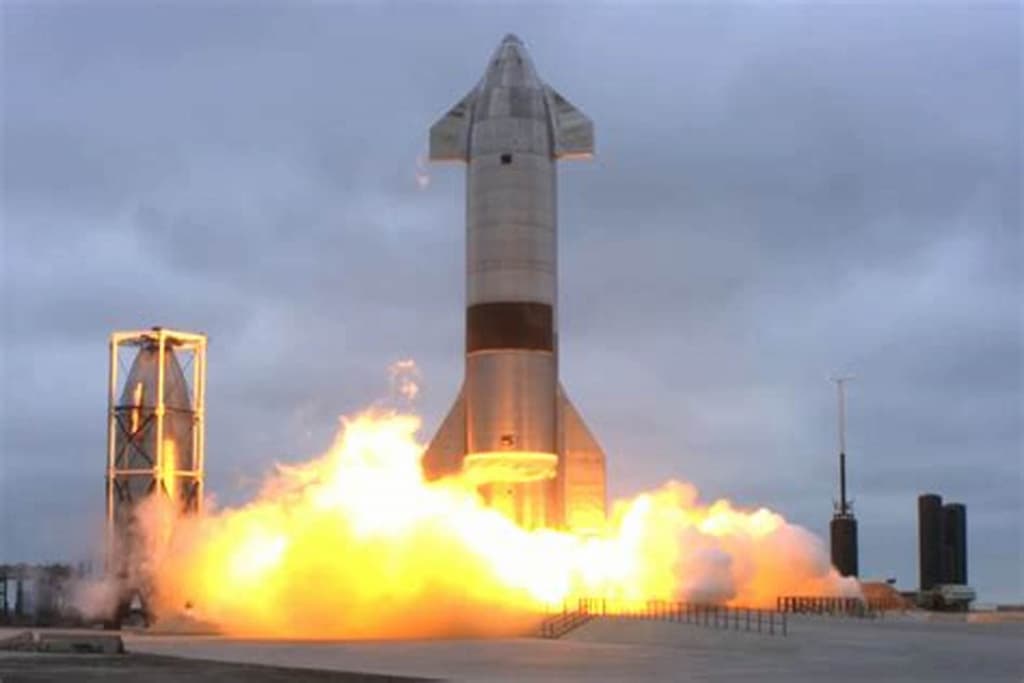
**Traders see a closely contested outcome between fewer than five and five-to-six Starship launches reaching space in 2026 because only two V3 flights have succeeded so far this year, both achieving suborbital trajectories, Starlink V3 deployments, and intact ship recoveries.** Flight 13 on July 24 demonstrated reliable Raptor 3 engine performance, a functional payload dispenser, and improved heat-shield survivability after reentry, yet the Super Heavy booster again experienced engine-out issues during boostback and landing burns. Regulatory timelines, hardware recovery from the Indian Ocean, and SpaceX’s decision to defer tower-catch attempts have pushed Flight 14 into mid-September or later, with the first true orbital mission still pending. While the company targets rapid cadence growth to support expanded Starlink capacity and Artemis objectives, recent schedule slips and the need for repeated booster reuse validation create uncertainty around whether the remaining four months will yield two-to-four additional successful flights or fewer.
Experimental AI-generated summary referencing Polymarket data. This is not trading advice and plays no role in how this market resolves. · UpdatedHow many SpaceX Starship launches reach space in 2026?
How many SpaceX Starship launches reach space in 2026?
<5 47%
5-6 45%
7-8 2.8%
>16 2.5%
$505,266 Vol.
$505,266 Vol.
<5
46%
5-6
45%
7-8
3%
9-10
2%
11-12
2%
13-14
<1%
15-16
<1%
>16
3%
<5 47%
5-6 45%
7-8 2.8%
>16 2.5%
$505,266 Vol.
$505,266 Vol.
<5
46%
5-6
45%
7-8
3%
9-10
2%
11-12
2%
13-14
<1%
15-16
<1%
>16
3%
A successful launch is defined as the Starship taking off from its launchpad and reaching a minimum altitude of 62 miles above sea level. Any subsequent anomaly (e.g., an explosion) after the vehicle reaches 62 miles will have no bearing on the outcome.
The primary resolution source for this market will be SpaceX’s official video feed of the launches (e.g., via SpaceX YouTube Channel), as well as secondary video feeds or written reports if necessary. However, a consensus of credible reporting may also be used.
Market Opened: Dec 11, 2025, 7:39 PM ET
Resolver
0x2F5e3684c...A successful launch is defined as the Starship taking off from its launchpad and reaching a minimum altitude of 62 miles above sea level. Any subsequent anomaly (e.g., an explosion) after the vehicle reaches 62 miles will have no bearing on the outcome.
The primary resolution source for this market will be SpaceX’s official video feed of the launches (e.g., via SpaceX YouTube Channel), as well as secondary video feeds or written reports if necessary. However, a consensus of credible reporting may also be used.
Resolver
0x2F5e3684c...**Traders see a closely contested outcome between fewer than five and five-to-six Starship launches reaching space in 2026 because only two V3 flights have succeeded so far this year, both achieving suborbital trajectories, Starlink V3 deployments, and intact ship recoveries.** Flight 13 on July 24 demonstrated reliable Raptor 3 engine performance, a functional payload dispenser, and improved heat-shield survivability after reentry, yet the Super Heavy booster again experienced engine-out issues during boostback and landing burns. Regulatory timelines, hardware recovery from the Indian Ocean, and SpaceX’s decision to defer tower-catch attempts have pushed Flight 14 into mid-September or later, with the first true orbital mission still pending. While the company targets rapid cadence growth to support expanded Starlink capacity and Artemis objectives, recent schedule slips and the need for repeated booster reuse validation create uncertainty around whether the remaining four months will yield two-to-four additional successful flights or fewer.
Experimental AI-generated summary referencing Polymarket data. This is not trading advice and plays no role in how this market resolves. · Updated
Beware of external links.
Beware of external links.
Frequently Asked Questions