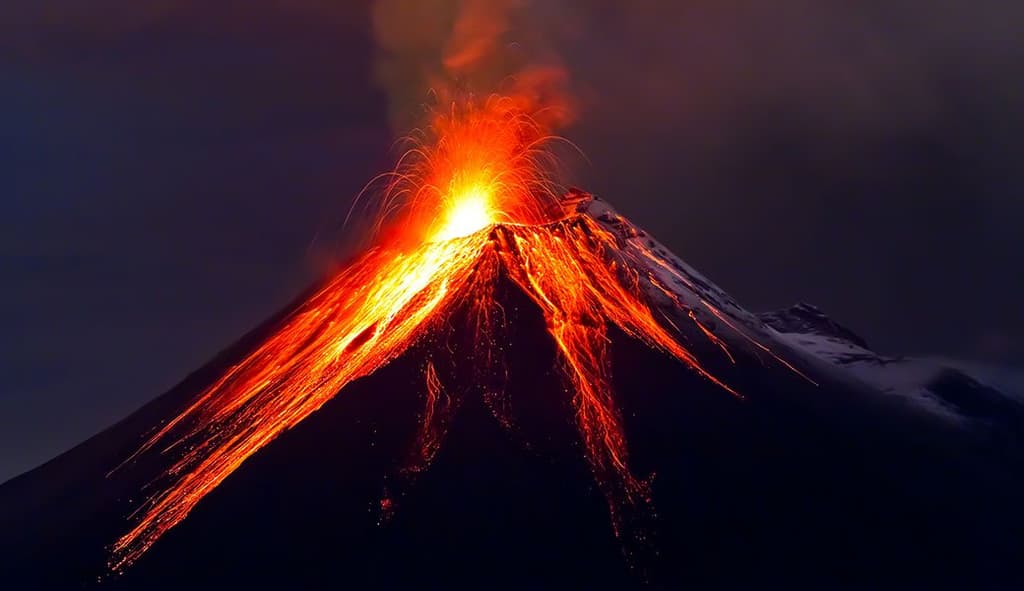
**Trader consensus favoring zero or one VEI ≥4 eruption in 2026 stems primarily from the statistical rarity of such events—typically 0–3 globally per year—and the absence of confirmed large explosive episodes through late August.** Ongoing activity at Semeru, Manam, and several Indonesian and Philippine volcanoes remains mostly at VEI 2–3 or lower, with Kīlauea’s episodic fountaining and Etna’s Strombolian phases producing limited tephra volumes. A May submarine eruption at Titan Ridge generated a significant plume and pumice rafts but is difficult to assign a definitive VEI on the subaerial scale. Official monitoring by the Smithsonian Global Volcanism Program and national agencies shows continued low-to-moderate explosivity at most sites, with no new model runs or satellite observations indicating imminent escalation to VEI 4 thresholds. This data environment supports the market’s 46.5 % probability on zero while leaving modest room for one additional event before year-end.
Experimental AI-generated summary referencing Polymarket data. This is not trading advice and plays no role in how this market resolves. · UpdatedHow many large volcano eruptions (VEI ≥4) in 2026?
How many large volcano eruptions (VEI ≥4) in 2026?
0 67%
1 21%
2 4.3%
5+ 1.0%
$1,156,715 Vol.
$1,156,715 Vol.
0
44%
1
21%
2
4%
3
1%
4
1%
5+
1%
0 67%
1 21%
2 4.3%
5+ 1.0%
$1,156,715 Vol.
$1,156,715 Vol.
0
44%
1
21%
2
4%
3
1%
4
1%
5+
1%
The primary resolution source will be the Smithsonian Institution Global Volcanism Program (GVP: https://volcano.si.edu/), specifically the cumulative figures for 2026 for VEI 4, VEI 5, and VEI 6 released on the page currently titled "Eruptions Avg 2000-2024 (N/T)" (https://volcano.si.edu/faq/index.cfm?question=eruptionsbyyear) as of March 31, 2027, 12 PM ET. Any prior updates will not be considered finalized.
If this dataset has not been updated to include all relevant events by March 31, 2027, or if the Smithsonian GVP becomes permanently unavailable, this market may resolve based on a consensus of credible scientific sources, including the U.S. Geological Survey (USGS), national or regional volcanic observatories, or credible reporting of a scientific consensus.
Note: Smithsonian Institution Global Volcanism Program databases, which include eruptions that reached the relevant threshold prior to this market’s timeframe (e.g., https://volcano.si.edu/faq/index.cfm?question=eruptionsbyyear&checkyear=2025), will not be considered.
Market Opened: Jan 2, 2026, 1:48 PM ET
Resolver
0x2F5e3684c...The primary resolution source will be the Smithsonian Institution Global Volcanism Program (GVP: https://volcano.si.edu/), specifically the cumulative figures for 2026 for VEI 4, VEI 5, and VEI 6 released on the page currently titled "Eruptions Avg 2000-2024 (N/T)" (https://volcano.si.edu/faq/index.cfm?question=eruptionsbyyear) as of March 31, 2027, 12 PM ET. Any prior updates will not be considered finalized.
If this dataset has not been updated to include all relevant events by March 31, 2027, or if the Smithsonian GVP becomes permanently unavailable, this market may resolve based on a consensus of credible scientific sources, including the U.S. Geological Survey (USGS), national or regional volcanic observatories, or credible reporting of a scientific consensus.
Note: Smithsonian Institution Global Volcanism Program databases, which include eruptions that reached the relevant threshold prior to this market’s timeframe (e.g., https://volcano.si.edu/faq/index.cfm?question=eruptionsbyyear&checkyear=2025), will not be considered.
Resolver
0x2F5e3684c...**Trader consensus favoring zero or one VEI ≥4 eruption in 2026 stems primarily from the statistical rarity of such events—typically 0–3 globally per year—and the absence of confirmed large explosive episodes through late August.** Ongoing activity at Semeru, Manam, and several Indonesian and Philippine volcanoes remains mostly at VEI 2–3 or lower, with Kīlauea’s episodic fountaining and Etna’s Strombolian phases producing limited tephra volumes. A May submarine eruption at Titan Ridge generated a significant plume and pumice rafts but is difficult to assign a definitive VEI on the subaerial scale. Official monitoring by the Smithsonian Global Volcanism Program and national agencies shows continued low-to-moderate explosivity at most sites, with no new model runs or satellite observations indicating imminent escalation to VEI 4 thresholds. This data environment supports the market’s 46.5 % probability on zero while leaving modest room for one additional event before year-end.
Experimental AI-generated summary referencing Polymarket data. This is not trading advice and plays no role in how this market resolves. · Updated

Beware of external links.
Beware of external links.
Frequently Asked Questions